Metadata
aliases: []
shorthands: {}
created: 2022-05-28 14:02:51
modified: 2022-05-28 14:26:36
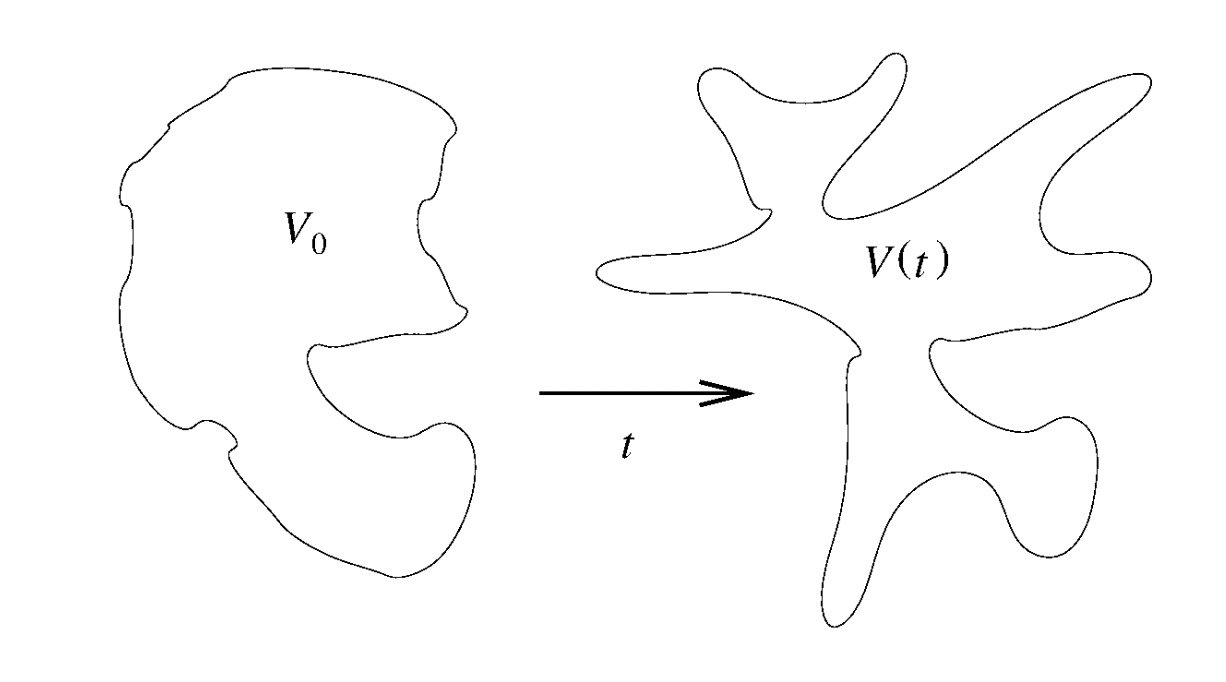
Liouville's theorem states that in Hamiltonian mechanics, an arbitrary
Let the physical system in question have
Also, let
Where the dots mean the time derivatives.
Then take the divergence of
Where we substituted the canonical equations (see Hamiltonian mechanics) which made the individual contents in the sum zero.
Due to the divergence theorem, this means that considering an arbitrary segment of the phase space, the "flow" described by